We live in a world that adores the self-made. We praise the ones who pull themselves up, who owe nothing to anyone, who stand entirely on their own two feet. And if we are not careful, that very same spirit slips quietly into the way we walk with God. We begin to imagine that our faith is something we manufactured, a status we earned, a position we secured by our own goodness. We forget that we were ever anything other than what we are now.
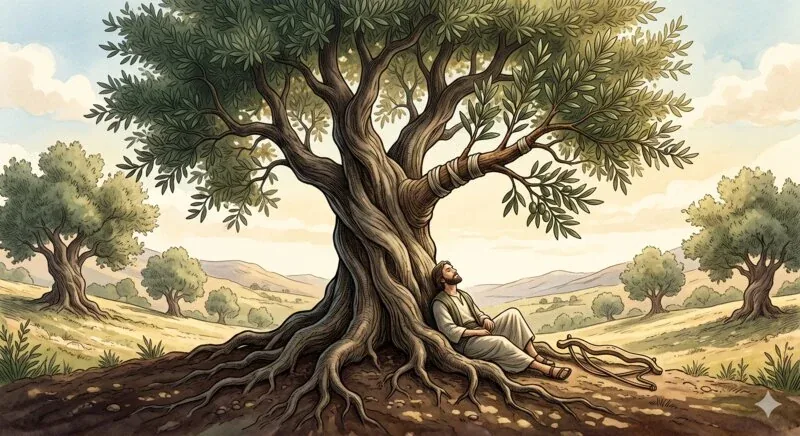
Into this forgetfulness, the Apostle Paul sets a humbling picture: an olive tree, an ancient root, and a wild branch that was grafted in where it had no natural right to be. Then he turns to that branch and gives it a warning it desperately needs to hear:
"Boast not against the branches. But if thou boast, thou bearest not the root, but the root thee."
— Romans 11:18 (KJV)
There is a particular kind of foolishness that only a branch could commit. Imagine a branch that wakes one morning quite pleased with itself: Look how green my leaves are. Look at the fruit I am bearing. And slowly it begins to believe the tree is fortunate to have it, forgetting that every drop of sap, every ounce of life, rises up from a root it has never even seen. That is the absurdity of spiritual pride. And it is precisely this pride that Paul, and then our Lord Himself, comes to heal. From these two passages we find three truths that strip away our boasting and replace it with something far better: a settled, grateful rest.
Paul is writing here to the Gentile believers, and he wants them to understand exactly how they came to belong to God. They were not the cultivated tree. They were the wild branch—cut from a tree that was wild by nature and grafted, contrary to nature, into a good olive tree. In other words, every spiritual blessing they enjoyed came to them by sheer, undeserved kindness. They contributed nothing to the root. They simply received its life.
This is the great leveler of the Christian life. We are not invited to look down on anyone, because we have nothing that we did not first receive. The natural branches that were broken off were not removed because the wild branches were superior; they were broken off through unbelief. And the wild branches do not stand because they are stronger; they stand by faith alone. You did not plant yourself. You did not grow the root, you did not dig the soil, you did not draw up the sap. You were grafted in by grace, and grace alone keeps you green.
When this truth truly lands on us, boasting becomes impossible. How can a branch be proud of fruit it did not produce by its own strength? Humility is not us thinking poorly of ourselves; it is us finally seeing clearly where our life actually comes from. The branch does not bear the root. The root bears the branch.
Having humbled the proud branch, Paul now hands us a phrase we must never lose. He tells us to hold two things together that our age would prefer to keep apart:
"Behold therefore the goodness and severity of God: on them which fell, severity; but toward thee, goodness, if thou continue in his goodness: otherwise thou also shalt be cut off."
— Romans 11:22 (KJV)
This is why Paul says, "Be not highminded, but fear." Not a cringing, slavish terror, but a holy, watchful reverence—the kind of fear that keeps a branch clinging tightly to the trunk. Presumption is the enemy here. The moment we treat grace as something we own rather than something we receive, we have begun the slow drift away from the very root that holds us. The remedy is not anxiety; the remedy is to continue in His goodness—to abide, to depend, to keep drawing our life from the source.
And do not miss the mercy folded into this warning. The same God who can cut off a presumptuous branch is mighty to graft a fallen one back in. Paul says God is able to graft them in again, for if a wild branch could be joined to a cultivated tree contrary to nature, how much more can the natural branches be restored to their own. There is no one so far gone that the kindness of God cannot reach them and graft them home. His severity warns us; His goodness calls us; and both are meant to drive us deeper into Him.
Now, if we stopped at Romans, we might be left trembling—aware of our dependence, afraid to presume, but unsure where to find peace. So our Lord Jesus completes the picture. Paul shows us the root; Jesus shows us the heart of the One the root belongs to. And He begins by telling us that no one even comes to know the Father by climbing up to Him on their own:
"All things are delivered unto me of my Father: and no man knoweth the Son, but the Father; neither knoweth any man the Father, save the Son, and he to whomsoever the Son will reveal him."
— Matthew 11:27 (KJV)
Knowing God is not seized; it is given. It is revealed. This is the same lesson as the grafted branch, spoken in a different key. We do not grasp our way into the life of God; we are drawn in, welcomed in, revealed to. And to those of us who have spent our lives straining to be our own root—carrying burdens we were never strong enough to bear—Jesus speaks the gentlest invitation in all of Scripture:
"Come unto me, all ye that labour and are heavy laden, and I will give you rest. Take my yoke upon you, and learn of me; for I am meek and lowly in heart: and ye shall find rest unto your souls. For my yoke is easy, and my burden is light."
— Matthew 11:28-30 (KJV)
Consider what He reveals about Himself: the Root we cling to, the One who holds all things, is meek and lowly in heart. This changes everything about the fear Paul described. We do not cling to a harsh master; we cling to a gentle Savior. The yoke that crushes us is the yoke of trying to be our own source—earning, proving, holding ourselves up by our own merit. The yoke Jesus offers is easy precisely because He carries the weight. The branch does not labor to produce sap; it simply abides, and the life of the root flows into it and bears fruit. That is rest. Not the rest of doing nothing, but the rest of finally drawing your life from the One who is strong enough to give it.
Two great dangers threaten every soul: the pride that says "I bear the root," and the despair that says "no root could ever bear me." Romans answers the first; Matthew answers the second. And the cure for both is the very same posture—humble, grateful dependence on a God who is both holy and gentle.
So to the proud branch, hear Paul: you did not plant yourself; be not highminded, but abide. And to the weary soul, hear Jesus: come unto me, and I will give you rest. Stop straining to hold yourself up. Let go of the burden you were never meant to carry alone. Be grafted into the One whose yoke is easy and whose heart is lowly, and rest in the simple, staggering truth of the gospel: you do not bear the root—the Root bears you. Let us abide in Him today.
The following gathers the principal KJV passages for studying this message in their wider biblical context.
Israel, the root, and the branches
Isaiah 11:1-12; Jeremiah 11:16; Hosea 14:4-8; Romans 9:1-8; 10:1-13; 11:1-36.
Grace and humility
Deuteronomy 7:6-9; Romans 3:21-28; 12:3; 1 Corinthians 4:7; Ephesians 2:8-10.
Abiding and bearing fruit
Psalm 1:1-3; John 15:1-17; Galatians 5:22-25; Colossians 2:6-7.
One people in Christ
Galatians 3:26-29; Ephesians 2:11-22; 3:1-12; 1 Peter 2:9-10.
Rest and the gentle yoke
Psalm 23; 62:1-8; Matthew 11:25-30; Hebrews 3:7-4:11; 1 Peter 5:5-7.
Prayer"Father, we confess that we are wild branches, grafted in by Your kindness and kept green by Your grace alone. Forgive us for the pride that imagines we bear the root, and forgive us for the despair that doubts the root could ever bear us. Teach us a holy fear that clings ever tighter to You, and grant us the rest that comes from finally letting go of the weight we were never meant to carry. Lord Jesus, You are meek and lowly in heart; we come to You, weary and heavy laden, and we take Your easy yoke upon us. Draw Your life through us, and let us bear the fruit of abiding in You. In Jesus' name, Amen."