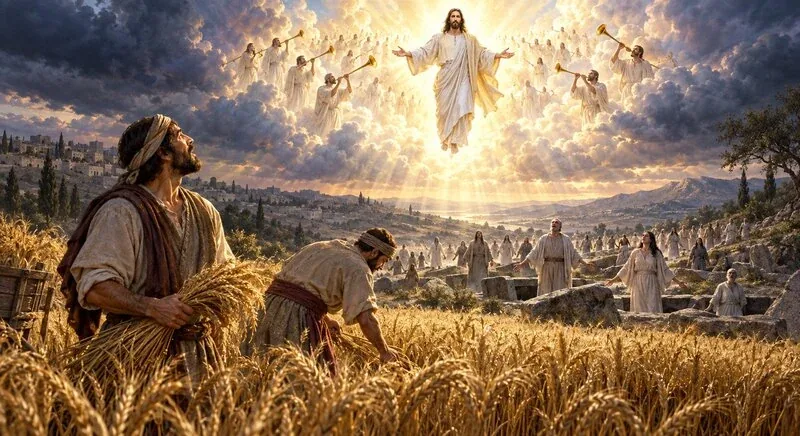
Few prophetic subjects produce more charts, arguments, and confident predictions than the rapture. Some teach that the Church will disappear secretly before tribulation. Others place the gathering during or after a period of suffering. Still others avoid the word entirely because it does not appear in the English Bible. Our task is not to defend a diagram inherited from a teacher. Our task is to hear the whole counsel of Scripture.
The English word rapture is not found in the King James Version, but the event commonly described by that word certainly is. Paul says living believers will be “caught up” together with the resurrected saints. The Latin rendering of that expression supplied the term from which “rapture” developed. Therefore, the right question is not, “Is the word rapture in the Bible?” The right question is, “What does Scripture say will happen when Christ gathers His people?”
“For the Lord himself shall descend from heaven with a shout, with the voice of the archangel, and with the trump of God: and the dead in Christ shall rise first: Then we which are alive and remain shall be caught up together with them in the clouds, to meet the Lord in the air: and so shall we ever be with the Lord.”
— 1 Thessalonians 4:16–17 (KJV)
This passage gives us the fixed points. The Lord Himself descends. His coming is accompanied by a shout, the voice of the archangel, and the trumpet of God. The dead in Christ rise. Living believers are caught up together with them. All meet the Lord, and from that moment they remain with Him forever. Paul presents this truth to comfort grieving believers, not to feed speculation.
Notice the order: resurrection comes before the catching up of the living. The Christian hope is not escape from having a body; it is the redemption and transformation of the body. The departed saints are not forgotten, and the living do not outrun them.
“Behold, I shew you a mystery; We shall not all sleep, but we shall all be changed, In a moment, in the twinkling of an eye, at the last trump: for the trumpet shall sound, and the dead shall be raised incorruptible, and we shall be changed.”
— 1 Corinthians 15:51–52 (KJV)
The moment is sudden, but sudden does not necessarily mean secret. Paul calls it the last trump. The dead are raised incorruptible, and the living are changed. Philippians 3:20–21 adds that Christ will change our vile body so that it may be fashioned like His glorious body. The gathering and bodily resurrection belong together.
Jesus did not describe His return as a private rumor discerned only after people vanish. He warned against claims that Christ had appeared secretly in a desert or hidden chamber. Then He compared His coming to lightning flashing across the sky.
“For as the lightning cometh out of the east, and shineth even unto the west; so shall also the coming of the Son of man be.”
— Matthew 24:27 (KJV)
“Immediately after the tribulation of those days shall the sun be darkened... And then shall appear the sign of the Son of man in heaven... and they shall see the Son of man coming in the clouds of heaven with power and great glory. And he shall send his angels with a great sound of a trumpet, and they shall gather together his elect from the four winds...”
— Matthew 24:29–31 (KJV)
Here again are the clouds, the trumpet, and the gathering. Revelation 1:7 says, “Behold, he cometh with clouds; and every eye shall see him.” Acts 1:11 declares that the same Jesus who ascended into heaven will come again in like manner. Whatever questions remain about prophetic sequence, the New Testament repeatedly presents Christ’s return as personal, bodily, triumphant, and public.
“Then shall two be in the field; the one shall be taken, and the other left. Two women shall be grinding at the mill; the one shall be taken, and the other left.”
— Matthew 24:40–41 (KJV)
These words are often treated as a complete explanation of the rapture, but Jesus places them inside the story of Noah. People carried on with ordinary life “until the flood came, and took them all away.” In that immediate comparison, those taken by the flood were taken in judgment while Noah was preserved. This means we must not automatically assume that “taken” always means taken safely to heaven.
Luke’s parallel makes the warning even sharper. Jesus speaks of Noah, then Lot, and then says one will be taken and another left. The disciples ask, “Where, Lord?” He answers, “Wheresoever the body is, thither will the eagles be gathered together” (Luke 17:37). That answer sounds like judgment, not a peaceful destination. Faithful interpreters differ about whether the one taken is gathered to Christ or removed in judgment, but the phrase itself cannot bear the entire doctrine. We must interpret the obscure saying by the clear teaching of 1 Thessalonians 4 and 1 Corinthians 15.
The central command in both accounts is not “calculate” but “watch.” Jesus says the day and hour are unknown. The separation will be decisive and personal. Two people may share a field, a mill, a home, or even a church pew, yet only genuine union with Christ prepares a soul for His appearing.
Paul directly joins “the coming of our Lord Jesus Christ” with “our gathering together unto him.” He then warns believers not to be deceived as though that day were already present.
“Now we beseech you, brethren, by the coming of our Lord Jesus Christ, and by our gathering together unto him... Let no man deceive you by any means: for that day shall not come, except there come a falling away first, and that man of sin be revealed...”
— 2 Thessalonians 2:1–3 (KJV)
Christians disagree about every detail in this chapter, including the identity of the restrainer and the timing of the man of sin. Yet Paul’s pastoral purpose is plain: do not be shaken, do not believe every prophetic claim, and do not let anyone deceive you. Scripture gives signs to produce endurance and discernment, never panic or date-setting.
The original 1611 King James Bible printed a collection commonly called the Apocrypha between the Testaments. These writings should be identified honestly and should not be used to overturn clear apostolic teaching. Nevertheless, they preserve ancient Jewish and Christian-era expectations concerning resurrection, judgment, tribulation, and the appearing of God’s Anointed.
“Nevertheless as concerning the tokens, behold, the days shall come, that they which dwell upon earth shall be taken in a great number, and the way of truth shall be hidden, and the land shall be barren of faith.”
— 2 Esdras 5:1 (KJV Apocrypha)
In context, “taken in a great number” is one of several fearful tokens of a world entering judgment; it should not be isolated as a technical description of the Church’s gathering. Second Esdras 6:23–28 also speaks of a trumpet, fear upon the earth, survivors seeing salvation, changed hearts, evil being extinguished, and truth flourishing. Second Esdras 2:42–48 pictures an innumerable multitude on mount Sion who have put off mortal clothing, received immortal clothing, confessed the name of God, and are crowned by the Son of God. Second Esdras 13 portrays the Son’s appearing, judgment upon wicked nations, and the gathering and defense of a peaceable people.
Other Apocryphal witnesses strengthen the hope of resurrection rather than provide a precise end-times timetable. Wisdom of Solomon 3:1–9 speaks of the righteous in the hand of God and their vindication in the time of visitation. Wisdom 5:15–16 speaks of the righteous living forever and receiving a glorious crown. Second Maccabees 7 records martyrs who endure death in hope that the King of the world will raise them to everlasting life. These themes harmonize with the New Testament’s emphasis: fidelity to God, resurrection, judgment, and immortal life.
The second attached quotation comes from 1 Enoch in the R. H. Charles translation. First Enoch is an important ancient Jewish work and is received as Scripture in the Ethiopian Orthodox Tewahedo tradition, but it is not a book of the KJV Apocrypha. It should therefore be labeled separately rather than presented as a KJV passage.
“And now I know this mystery, that sinners will alter and pervert the words of righteousness in many ways, and will speak wicked words, and lie, and practice great deceits, and write books concerning their words.”
— 1 Enoch 104:10 (R. H. Charles)
This warning is relevant to our method. End-times teaching attracts sensational claims, altered meanings, false dates, and books that can become more authoritative to readers than Scripture itself. We should test every system by the words of Christ and His apostles. A dramatic theory is not true merely because it is repeated often.
- Jesus Christ will personally and visibly return in power and glory.
- His coming will be announced with heavenly authority and the trumpet of God.
- The dead in Christ will be raised bodily and incorruptibly.
- Faithful believers who are alive will be instantly transformed.
- Together, the resurrected and transformed saints will be caught up to meet the Lord.
- Christ will judge evil, gather His people, and establish the everlasting victory of His kingdom.
- No human being knows the day or hour; therefore every generation is commanded to watch, remain sober, and be ready.
The blessed hope is not that Christians will avoid every hardship. The blessed hope is Jesus Christ Himself. Believers throughout history have endured tribulation, persecution, and death, yet none of those things can separate them from Christ. Whether we sleep in death before His appearing or remain alive until that day, our promise is the same: “so shall we ever be with the Lord.”
The following groups the principal passages concerning Christ’s return, resurrection, the gathering of believers, judgment, and readiness.
Christ’s visible return
Matthew 24:27-31; Mark 13:24-27; Luke 17:22-37; 21:25-28; Acts 1:9-11; Revelation 1:7; 19:11-16.
Resurrection and transformation
Job 19:25-27; Daniel 12:1-3; John 5:28-29; 6:39-40; 1 Corinthians 15:20-26, 35-58; Philippians 3:20-21; 1 Thessalonians 4:13-18; Revelation 20:4-6.
Taken, left, and watchfulness
Matthew 24:36-51; 25:1-13; Luke 12:35-48; 17:26-37; 21:34-36; 1 Thessalonians 5:1-11.
Gathering, apostasy, and judgment
Matthew 13:24-30, 36-43, 47-50; 2 Thessalonians 1:6-10; 2:1-12; Revelation 14:14-20; 20:11-15.
Blessed hope and readiness
Titus 2:11-14; Hebrews 9:27-28; James 5:7-9; 1 Peter 1:3-7, 13; 2 Peter 3:3-14; 1 John 2:28-3:3; Revelation 22:7, 12, 20.
KJV Apocrypha witness
Wisdom of Solomon 3:1-9; 5:15-16; 2 Maccabees 7:9, 14, 23, 29, 36; 12:43-45; 2 Esdras 2:16, 34-48; 4:35-43; 5:1-13; 6:18-28; 7:26-44; 13:16-26, 29-39, 48-50.
Historical extra-biblical witness
1 Enoch 104:10 (R. H. Charles). Included for historical context and discernment; it is not part of the KJV Apocrypha.
Readiness is not achieved by solving every disputed timeline. It is found in repentance, faith, holiness, love, and perseverance in Jesus Christ. The wise virgins were ready when the Bridegroom came. The faithful servant was doing his Master’s work. Paul tells us to comfort one another with the promise of resurrection and reunion.
Do not fear tomorrow more than you trust Christ today. Do not follow every rumor that says, “Lo, here is Christ,” or “there.” Keep your lamp burning. Hold fast to truth. Encourage the grieving. Refuse deception. And live so that whenever the trumpet sounds—whether in our lifetime or after we sleep in Christ—we may meet the Lord with joy.
Prayer“Lord Jesus Christ, keep us watchful without fear, discerning without pride, and hopeful without speculation. Anchor us in Your Word. Comfort those who grieve with the promise of resurrection. Guard us from deception, cleanse us from sin, and teach us to live faithfully while we await Your glorious appearing. Whether we wake or sleep, let us be Yours, and gather us with all Your saints when the trumpet sounds. Amen.”